
In April 2026, the team of obszidian.hu continued its series of study visits aimed at exploring Eurasian obsidian geological sources in the Armenian Highlands, this time in the northern part of the landscape, within the territory of modern-day Armenia. In the following photo report, we present our encounter with “Armenian obsidian,” known locally as “vanakat.”
■
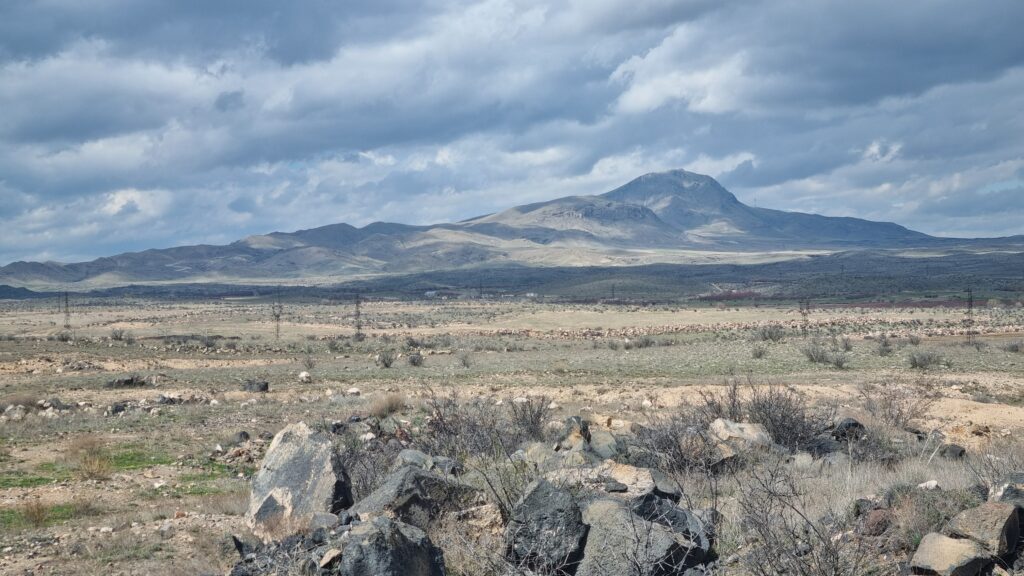
Comprising Tertiary and Quaternary volcanic formations, the Armenian Highlands, researchers have identified a total of about twenty obsidian deposits where, from the beginning of the Paleolithic era (Lower Paleolithic) through the Early Iron Age, virtually inexhaustible quantities of high-quality obsidian were available on the surface. In addition to the richest primary geological sources (Arteni, Spitakasar, Geghasar, Hatis), sufficiently large obsidian pebbles found in the river valleys of the surrounding rivers (e.g. Marmarik, Kasakh, Hrazdan, Vorotan) were also collected. Obsidian in Armenia is not just a thing of the past: thanks to the Vanakat Company (https://obsidianarmenia.com), it is also a part of the present. The company name refers to the local name for obsidian. We have written about this topic in detail on our website in a philological post titled “Obsidian – Nomen est omen (3.)”, which discusses the origin and meaning of the name “obsidian” as well as its other names.
■

As the first stop on our study tour, following preliminary contact via email, we visited the Yerevan office of the Vanakat Company. The company, named after the Armenian word for obsidian, has been engaged in mining operations since 2017 in the Arteni (Արտենի) Mountains, located in the Aragatsotn (Արագածոտն) province in the south-western part of the country. The owner couple, Grigori Khachatryan and Zara Karapetyan, shared their personal connection to obsidian, both as the subject of their business and as this “marked” and “healing” stone, during a friendly conversation, despite it being our first in-person meeting.
Vanakat Company maintains business relationships with numerous partners in Europe and Asia, whose activities range from jewellery manufacturing thorough the service sectors till the electronics industry. Their key partners are located in China and The United Arab Emirates. Their connections in Cuba stem from Grigori’s “other” passion: cigar smoking. They also maintain close professional and business ties with partners in France.
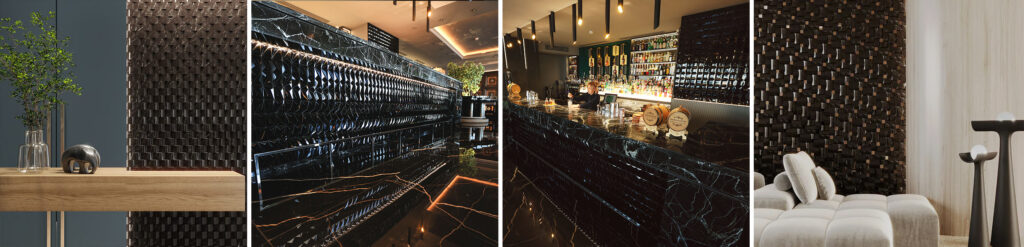
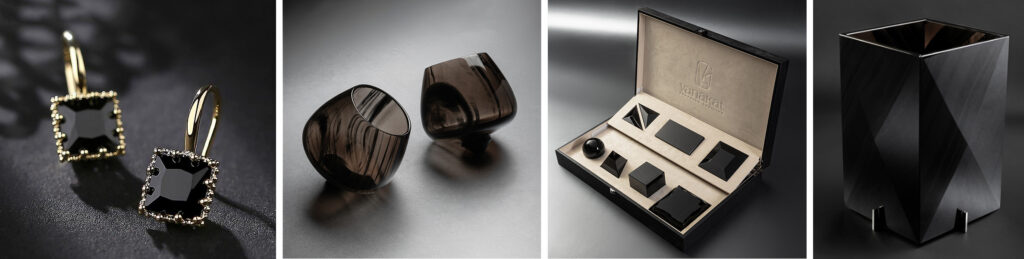
Rough obsidian stone still plays a prominent role in sales today: the jewellery industry is particularly fond of the translucent, banded volcanic glass from the Arteni volcano. In addition to the “traditional” black and red (mahogany) colour variants, they also sell a true rarity: “silver”-coloured obsidian (which shimmers due to micron-sized air bubbles and inclusions). The selection of decorative items is very wide and exclusive: vases, cheese plates, trays, glasses, toothbrush holders, soap dishes, and smoking accessories ranging from ashtrays to cigar holders. It is worth highlighting the particularly beautiful tile walls, one of which we were able to admire at the Paris Hotel Montmartre Restaurant in the modern centre of Yerevan.
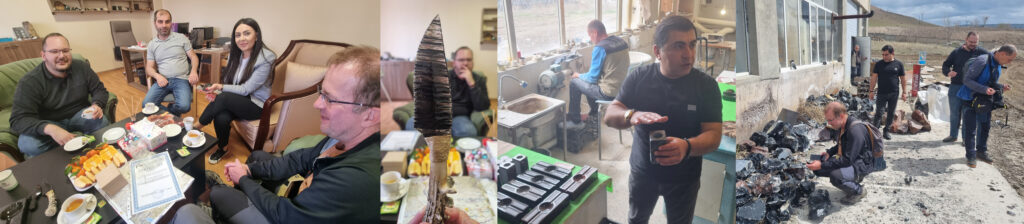
The company has high hopes, likely not without good reason, for a new product development and the expansion of its partnerships. At the request of a Chinese partner, research is underway to produce silicon dioxide (silica) of the highest possible purity from rough obsidian stone. The silica content of the obsidian found at the geological sources of the Arteni volcano, similarly to the black volcanic glass from the Carpathian (Zemplén) sources, is inherently high (75.85%; according to studies by the Institute of Geological Sciences in Armenia). From this raw material, silica of particularly high purity, 95–96% according to current knowledge, is produced through physical and chemical processes. The prospective applications of silicon extracted from obsidian include the electronics industry, the beauty industry, and the construction industry.
■
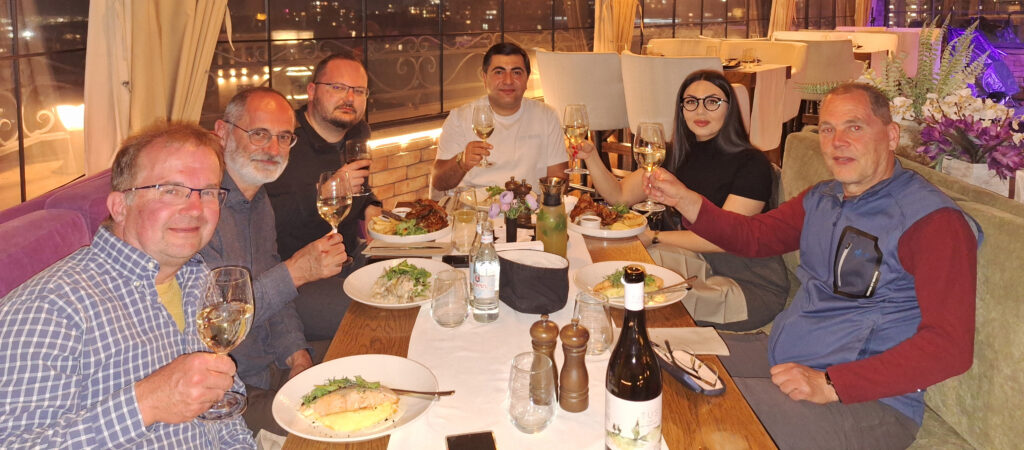
We held our private meetings and informal discussions over dinner at the Montmartre Restaurant, located on the rooftop terrace of the company-owned Paris Hotel. The restaurant is known not only for its high-quality cuisine but also for the unbelievable beautiful view from its rooftop terrace: above the downtown of Yerevan, the sacred mountain of the Armenians, Mount Ararat (5,137 m a.s.l.) dominates the landscape. (In August 2009, our team climbed the biblical mountain towering over Turkey during a three-day trek.)
■

We continued our study visit by visiting one of the richest obsidian sources in the Armenian Highlands: Mount Arteni, which rises to a height of 2,047 meters at its peak. During the Pleistocene epoch of geological history, approximately 1.4–1.2 million years ago, an unparalleled quantity of obsidian was formed as a result of volcanic activity. The Vanakat Company purchased the deposits located at the south-western foot of the mountain, covering approximately 150 hectares, and it is from here that obsidian blocks of various sizes are transported to the Yerevan facility. During our tour of the obsidian quarries, we were assisted by the supervisor of the Vanakat Company quarries, a former high-ranking official (governor) of the surrounding villages.
■
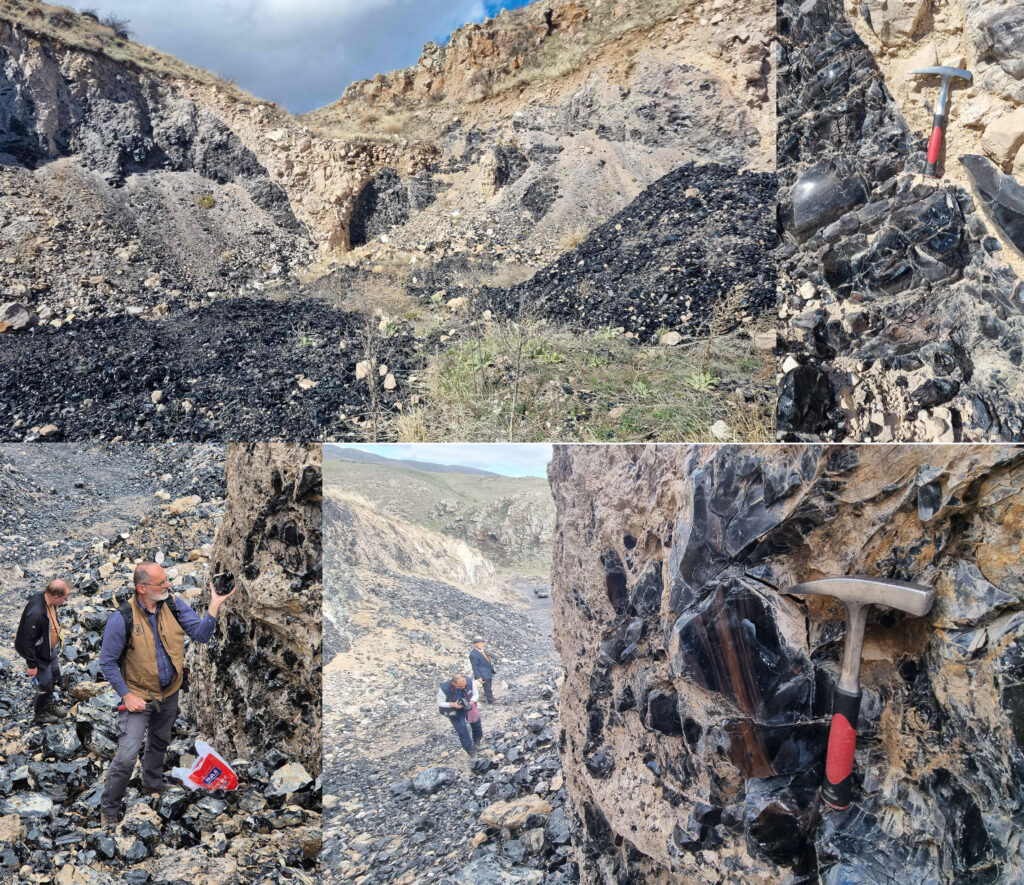
The appearance and character of the obsidian found in the two quarries we visited are particularly varied. In addition to black obsidian, there is also a type known as “mahogany” obsidian, which features an interplay of black and red hues. Particularly exciting are the specimens with straight and wavy banded patterns. One of the distinctive features of the obsidian found here is its translucency, which allows the rock’s internal structure to be examined even at first glance, without the use of a microscope.
■
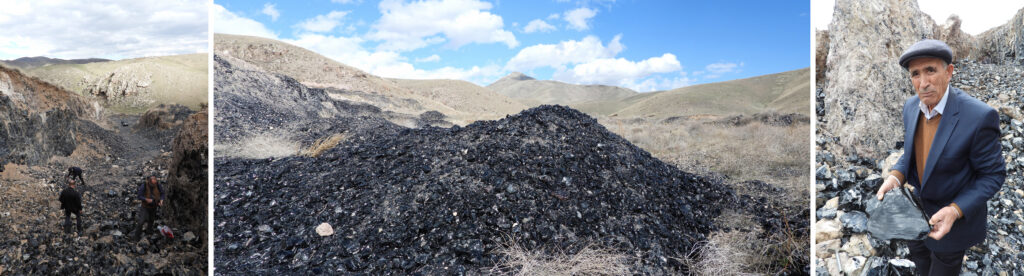
At the sites of the Arteni volcano that we have explored, it is not only the astonishing quantity and varied character of the obsidian that is impressive. In the quarries, we also made observations regarding the formation of obsidian. The smaller quarries revealed the contact between obsidian and pumice-perlite, the transitions between hyaline-textured, glassy rhyolite varieties and porphyritic rocks, and the context of the obsidian.
■
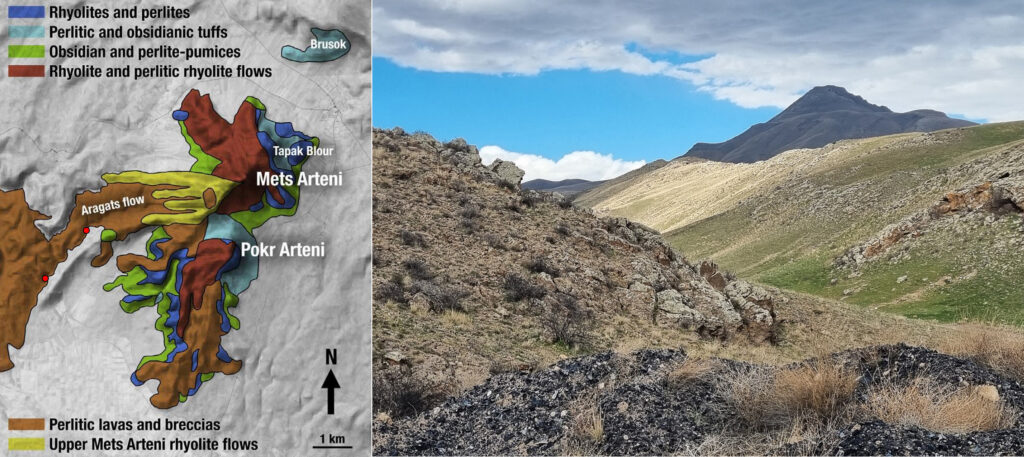
The Arteni volcanic complex consists of two eruption centres: Mets (“Big”) Arteni and Pokr (“Small”) Arteni. Both centres produced high-quality obsidian and large quantities of perlite and pumice deposits during rhyolitic eruptions approximately 1.2 ± 0.1 and 1.4 ± 0.2 million years ago. Interestingly, the Vanakat Company’s mining area (150 hectares, 15 million tons of obsidian reserves), along with numerous small quarries, is not located within the area of surface obsidian flows, but rather exposes obsidian buried by the pumice-perlite layers of the so-called Aragats flow. The Arteni-A obsidian deposit is located on the eastern side of Pokr Arteni, Arteni-B is present in the pyroclastic rocks at the so-called Brusok, northeast of Metz Arteni, while the extensive Aragats flow extends 8 km west of Metz Arteni. (It remains unclear how the various chemical varieties of obsidian found here fit into the series of eruptions of the Arteni volcano that produced extensive perlite deposits.) The numerous surface occurrences of all three high-quality obsidian varieties were important sources of raw materials in prehistory and antiquity.
■
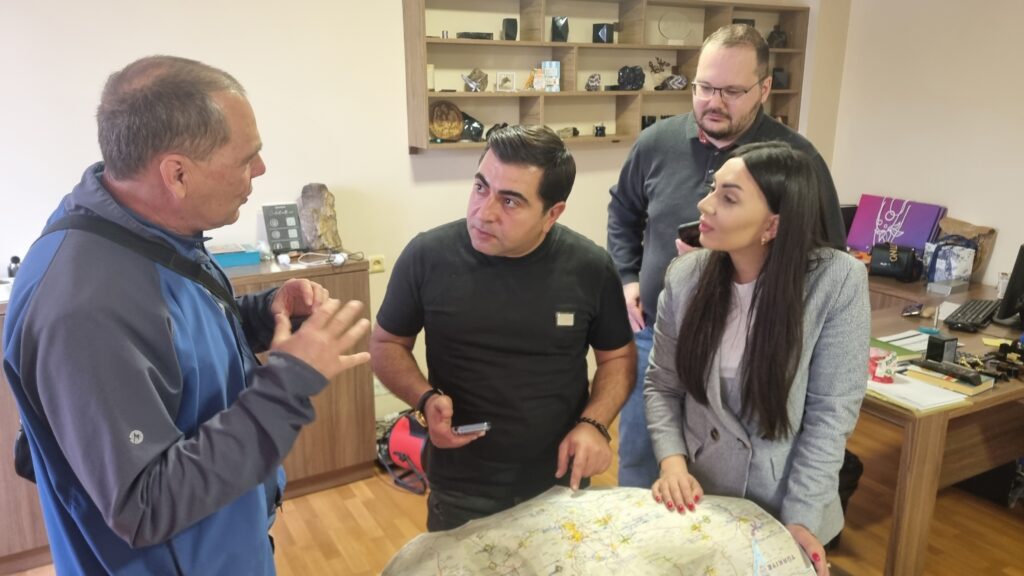
We would like to say thanks once again to our new Armenian friends, Grigori Khachatryan and Zara Karapetyan, for their expert guidance, which helped us to get acquainted with our shared passion, the Vanakat.